The creative blind spot in hotel growth

Hotels are still obsessing over targeting, reach, and channel mix while overlooking the biggest driver of market success: creative quality. Disconnected creative, media, and brand strategies are limiting sustainable growth. To compete in today’s consideration-led market, hotels need all three working together to Find, Book, and Grow.
Hotels don’t compete at the point of booking.
The reality is, you’re competing to stay in travelers’ minds throughout the entire decision-making journey. This consideration-led market is now our reality. And it means growth depends on influencing preference and intent long before a reservation is processed.
Winning brands have changed the way they compete. Previously, growth strategies focused almost entirely on market penetration and mass marketing. Today, up to 80% of growth comes from building and sustaining consideration (Cendyn-Google Summit, 2025).
That means hotels can no longer rely on media spend alone. Treating creative, media, and brand as separate disciplines means wasted spend, inconsistent messaging, and weaker campaign performance.
Creative quality has become the biggest driver of success. And this changes everything about how hotels should approach marketing.
Creative is now the engine of media performance
One of the biggest misconceptions in hotel marketing is that media performance is driven by channel strategy or spend levels. But creative quality contributes to nearly 50% of media impact, and brands can more than double their ROI by adopting creative best practices.
That means even the best media strategy struggles if the creative isn’t effective.
For hotels, this creates a growing challenge. Marketing teams are under pressure to deliver short-term bookings while simultaneously building long-term brand demand. At the same time, travelers expect increasingly personalized, relevant experiences across every touchpoint.
Travelers don’t need to see the same sunset pool shot fifteen times before they book. Repetitive hotel creative is losing effectiveness. Fast.
Creative fatigue is rising. Travelers see thousands of ads every day. Repetition no longer builds familiarity; it desensitizes potential guests. What drives performance now is fresh, diverse, high-quality creative that adapts to different audiences, behaviors, and stages of the guest journey.
But scaling creative production manually is difficult, expensive, and often too slow to keep pace with media optimization. This is where adding AI into the workflow can make a difference.
Instead of waiting until campaigns underperform to make adjustments, AI-powered creative prediction enables hotels to test and evaluate creative earlier. Using tools such as Google’s creative scorecard helps teams identify weak assets before a significant media budget is committed. High-frequency repetition of the same old room and spa shots is subtly phased out. It’s replaced by a continuous refresh of personalized creative that builds consideration over time.
Optimization moves from being reactive to proactive.
Media strategy can’t operate independently anymore
Creative insights need to move at the speed of media optimization. Currently, 53% of marketers say creative insights arrive too late to impact active campaigns.
While insights are delayed, reporting focuses on channels instead of overall business outcomes. Optimization happens in disconnected stages.
The result is slower decision-making, weaker creative performance, and wasted spend.
Hotels can no longer afford to treat media strategy as simply choosing channels and allocating budget. Media, creative, insights, production, and measurement now need to operate as one connected system.
The strongest campaigns are no longer built around isolated channel performance. They are built around unified frameworks where creative and media continuously inform one another.
Brand and performance are no longer opposites
Hotels have spent years thinking of brand campaigns and performance marketing as separate things. Brand campaigns were long-term investments focused on awareness; performance campaigns were designed to drive immediate bookings and measurable return on ad spend (ROAS).
But travelers don’t experience marketing in silos. And this no longer reflects how travel decisions are made.
In fact, brand builds future demand, while performance captures existing demand. The stronger the brand, the more effective performance marketing becomes.
Even a 1% lift in brand identity can drive an 11% increase in customer lifetime value, while also reducing price sensitivity by 10% (Cendyn-Google Summit, 2025). Strong brands don’t just attract attention. They make conversion easier, and they keep demand flowing long after a campaign ends.
And yet, this is where hotel marketing often makes a short-term trade-off that feels logical in the moment, but costly over time.
Brand budgets get trimmed to ‘protect’ performance metrics. ROAS looks healthier for a quarter or two. But the underlying demand pipeline quietly weakens. Hotels then find themselves working harder, and paying more, just to stay visible.
That’s the cycle: less brand investment today, more paid pressure tomorrow.
Hotels that take a different approach see a very different outcome. Consistent brand-building doesn’t deliver a one-off spike; it compounds. It strengthens recall, improves conversion efficiency, and steadily reduces reliance on constant paid acquisition to fill rooms.
The goal is no longer choosing between brand and performance. It’s building a full-funnel strategy where both work together.
A smarter growth strategy for hotels
The hotels that succeed in today’s market won’t be the ones producing the highest volume of creative assets or spending the most on media.
They’ll be the ones that unify creative, media, and brand strategy into a single framework designed to build consideration, validate performance early, and optimize continuously.
What should hotels focus on?
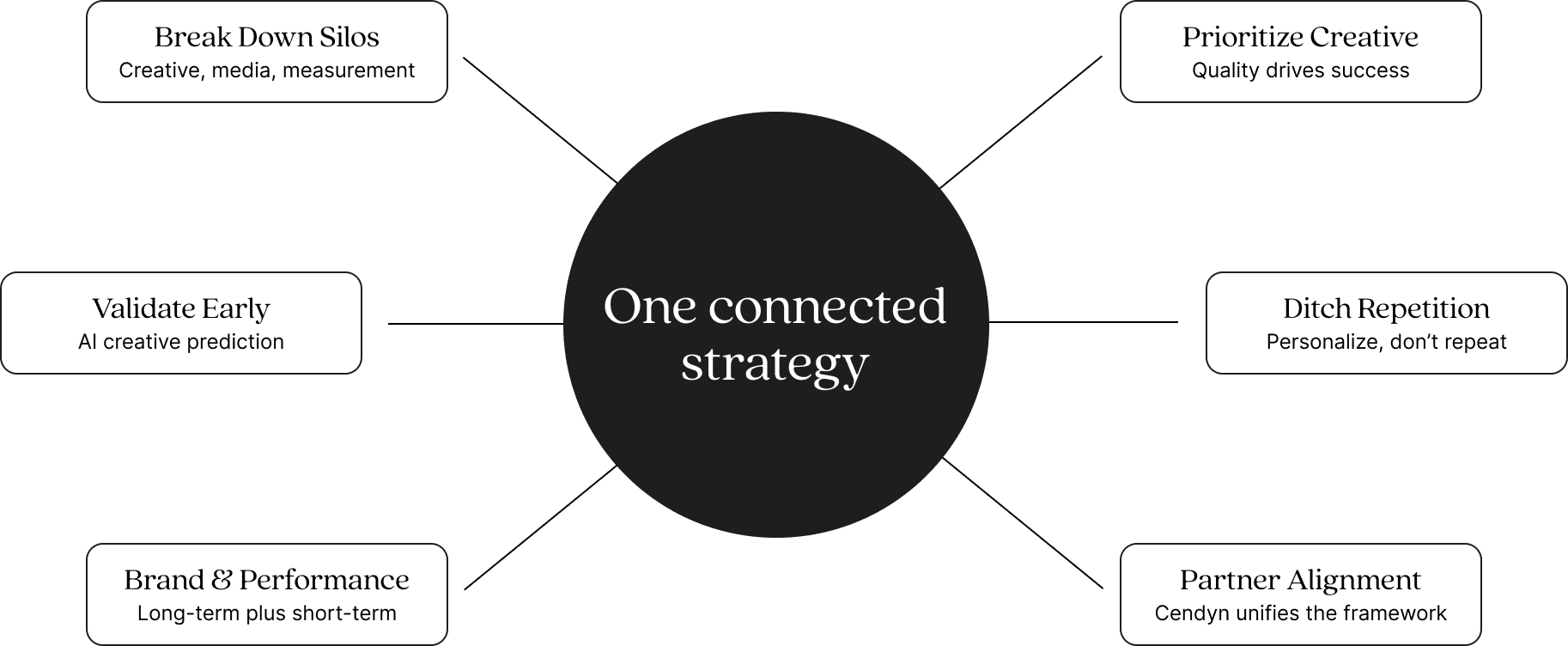
- Break down silos. Creative, media, production, and measurement should operate within one connected strategy.
- Prioritize creative quality. Strong creative is now one of the biggest drivers of campaign success.
- Validate early. Use AI-powered creative prediction to identify underperforming creative to test before you spend.
- Ditch repetition. Diverse, personalized creative is more effective than high-frequency ad exposure.
- Embrace brand and performance. Strengthen conversion and reduce acquisition costs with long-term brand investment.
- Align with the right partner. Cendyn helps hotels unify creative, media, and brand strategy into one framework that balances short-term performance with long-term brand growth.
Creative is now the performance advantage
Growth in hospitality has fundamentally changed. Now, consideration drives performance. Creative drives media effectiveness. And brand strength drives long-term profitability.
The hotels that win won’t be the ones spending the most on media. They’ll be the ones connecting creative, media, and brand strategy into one system designed to build consideration, capture demand, and drive long-term growth. This is the next evolution of every hotel’s Find, Book, and Grow strategy.